Tailored, Not Customizable
Why your business rules don't fit a template dashboard
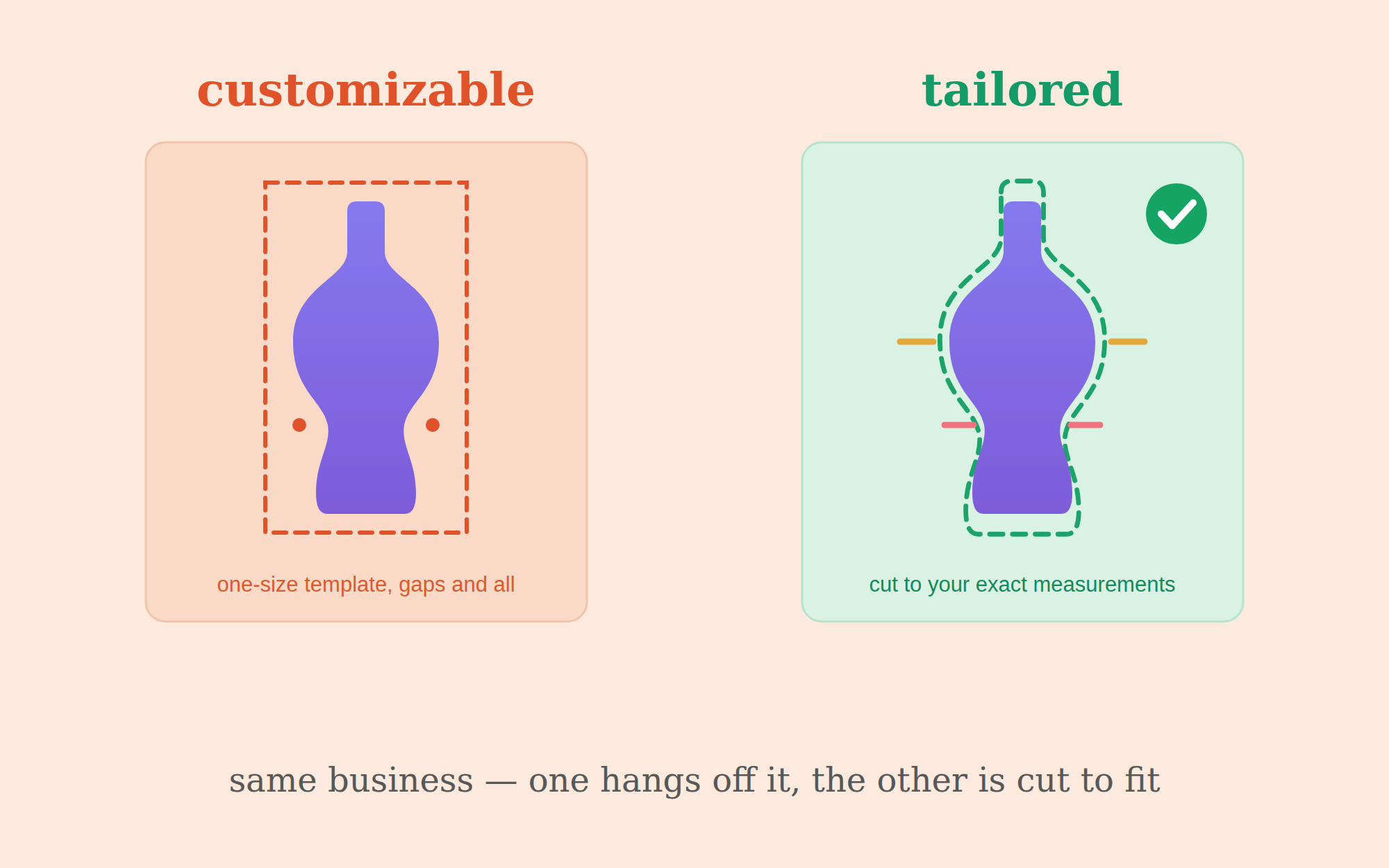
"Customizable" means you bend your business to fit the tool. "Tailored" means the tool learns your business. That's not a word game. It's the whole difference.
Every BI tool on the market calls itself customizable. Move the widgets, pick your colors, drag a field into a chart. Sounds like flexibility — right up until you try to make it hold your actual business.
Because your business doesn't fit the template. Nobody's MRR definition is the standard one. You have a rule about when an annual deal gets recognized. You treat that one weird reseller differently from everyone else. Your comp plan has holdbacks, accelerators, and a clawback that only kicks in after four confirmed payments. Your variance report breaks out the exact line items your CFO cares about, in the order she reads them.
None of that lives in a dropdown.
Configure vs. encode
A customizable tool lets you configure — pick from the options the vendor already built. What you need is to encode — capture how your business actually works, including the parts that aren't on the menu.
That's a much bigger ask, and it's where most tools quietly hand the problem back to you: "Sure, you can do that. You'll just need to model it upstream."
Translation: go build a pipeline, define the metrics, write the transformations, and maintain all of it forever. That's a data engineering team. Most $10–100M companies can't justify one, so the work lands on whoever's best with spreadsheets — and the customizable dashboard ends up sitting on a pile of manual work that undoes the entire point.
What tailored actually means
DataFabrIQ runs the other direction. Instead of asking you to squeeze into a template, it encodes your business logic directly: your MRR definition, your commission rules, your variance lines.
This is the work a data engineering team would do for you, if you had one. Unify the source systems. Define the metrics everyone agrees on. Turn your specific rules into logic that runs the same way every time and traces back to where every number came from.
No template to fight. No "well, the tool doesn't really work that way."
Why the distinction matters
The alternative is a slow, expensive kind of wrong. Bend your business to a template and the numbers still compute — they just don't reconcile. MRR is close, but not how finance counts it. The commission report is close, but not what you actually owe.
Close is where trust dies. Everyone can feel the gap even when nobody can point to it. And once your team stops believing the dashboard, they go back to the spreadsheet — and now you're paying for both.
Tailored closes that gap. The number on the screen is the number as your business defines it, not the vendor's best guess at what you probably meant. That's the difference between a dashboard people tolerate and a system an executive team runs the business on.
So when you're evaluating tools, don't ask how customizable it is. Ask whether it can encode your rules — the real ones, the weird ones, the ones that make your business yours — without asking you to build a data team first.
If your business runs on rules no template quite fits, come see what we're building: datafabriq.co