You Could Probably Build Your Next AI Workflow Yourself. Here's Why You Shouldn't.
The build is the easy part. Owning the fragile machine forever is the part nobody quotes you on.
Every leader has had the thought: I could build this report myself. You're staring at yet another disconnected report, and have Claude open in the next tab to guide you: pull the data from Salesforce, NetSuite, and QuickBooks, have the LLM write the transformations, and stand up a dashboard. A day of work, maybe two, to solve a problem that has been plaguing your team since you joined the company.
And you're not wrong. You probably could. The problem isn't whether you can build it — it's what you own the day after you do.
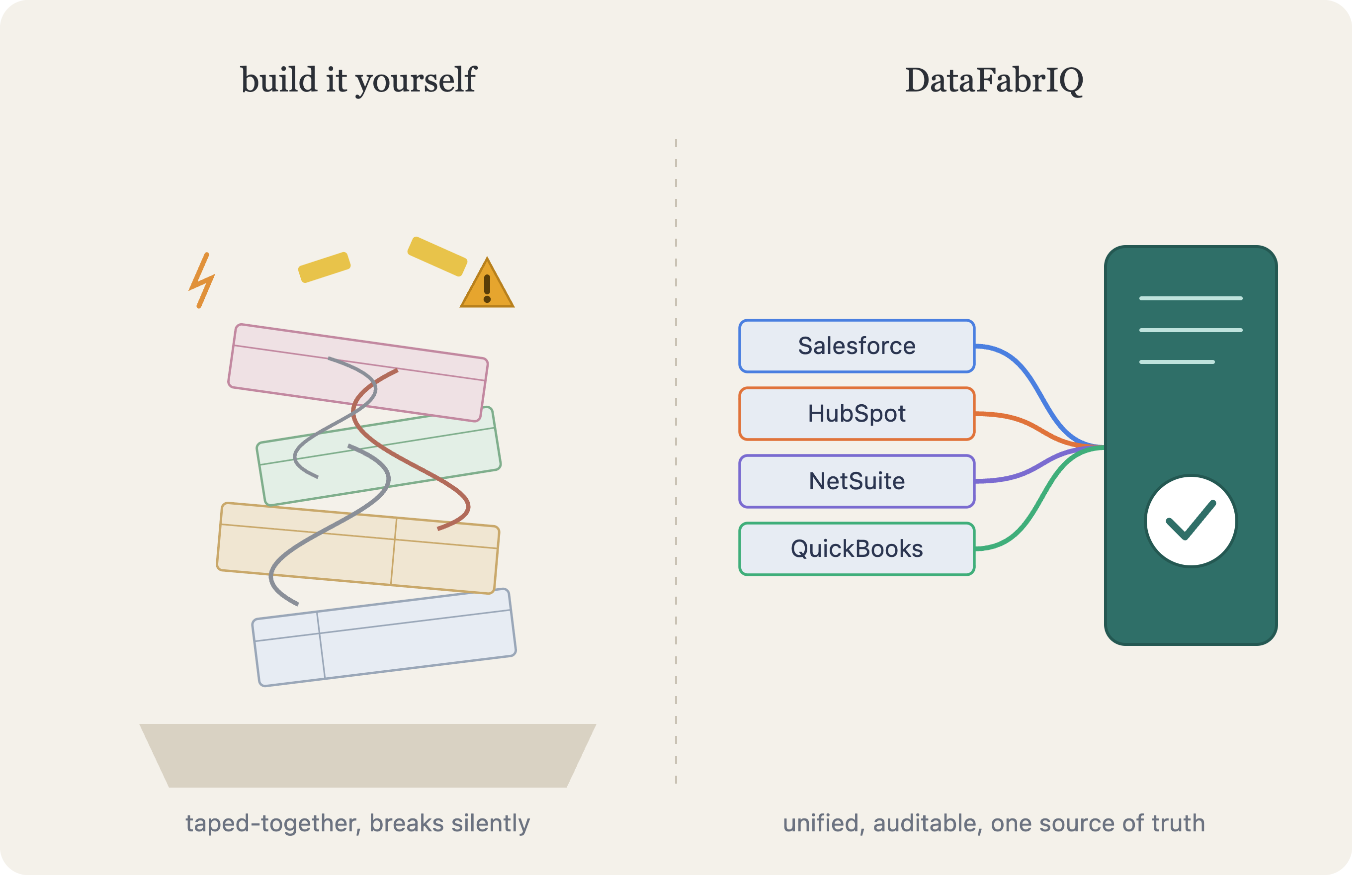
The build is a weekend. Data maintenance is forever.
The prototype always looks great. Then a source system changes a field name and the pipeline silently breaks. A rollforward stops tying out and nobody notices until the board deck is wrong. The one person who understood the whole chain of scripts is out of office, and no one can agree on what the correct number is.
This is the hidden cost of building AI workflows before you have one auditable source of truth for your data. It's the maintenance, the debugging, and the opportunity cost of your best people babysitting janky dashboards instead of making decisions. Vibe-coded infrastructure demos beautifully and scales terribly. The gap between "it worked in the chat window" and "the whole company trusts it" is enormous, and that gap is exactly why you need a governed data foundation and framework to build on.
"Do I need a data team for this?"
Usually, yes — that's the historical answer. Stitching Fivetran, dbt, and a BI tool together, or hand-rolling the equivalent with an LLM, is the work of a data team. Most growing companies can't justify that hire, so the work quietly falls to whoever is best with spreadsheets.
DataFabrIQ is the operational data platform that does that job instead. It unifies your source systems into one governed, auditable model and manages the workflows you actually run the business on — reconciliations, MRR closes, variance reports — with every number traceable to its source record.
How is this different from a semantic layer?
Fair question, because a semantic layer like dbt or Cube solves part of this — it defines metrics consistently. But it's still a component you assemble, host, secure, and maintain, and it stops at definitions. DataFabrIQ is the whole platform: ingestion, the governed data lakehouse, the ready-to-run workflows, and the auditability, delivered as a product. We take care of the hard, unglamorous work of making it scalable and secure so you don't have to.
That's the real trade. Building it yourself means owning a fragile machine forever. Your team's value isn't in maintaining the golden-truth spreadsheet — it's in the strategic decisions that the spreadsheet was supposed to inform. So skip the build, and keep your people on the work only they can do.
Ready to learn more? Contact us